


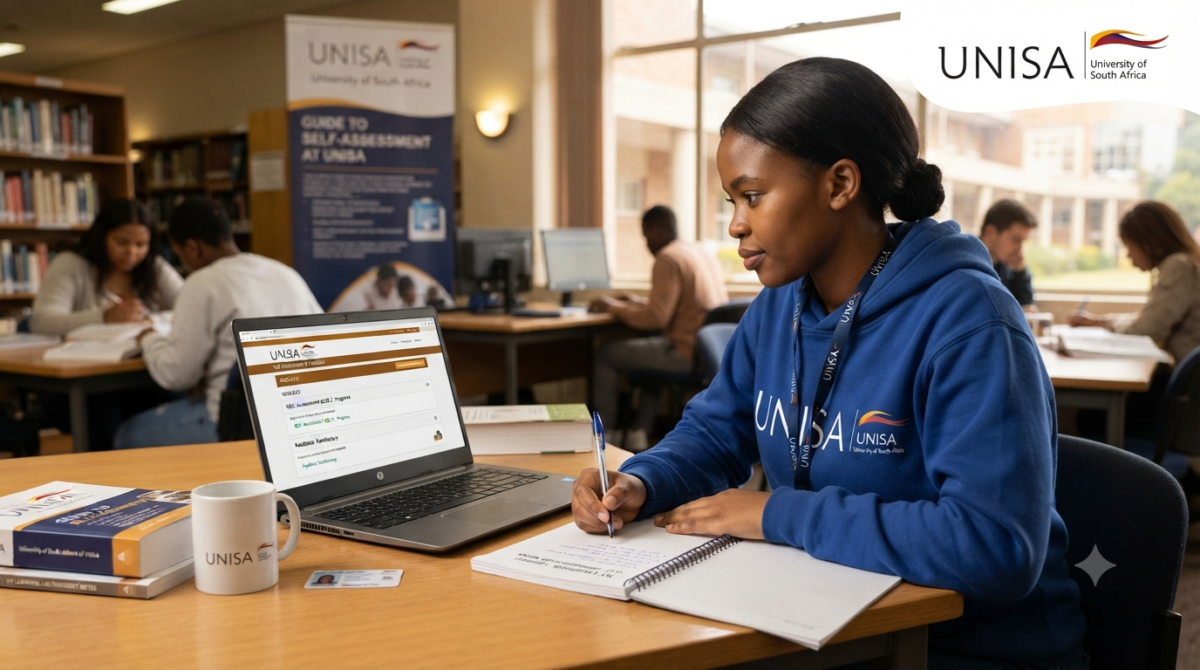
What Is Self-Assessment ?
A self-assessment is a process through which you can learn more about yourself and measure your growth. You can perform self-assessments according to a variety of criteria, including development, skills and relationships.
- Learning Log. A learning log serves as a personal journal for students to record their thoughts, questions, and experiences on their educational journey. …
- Reflective Journals. …
- Goal Setting. …
- Rubric Self-Assessment. …
- Questionnaires or Surveys. …
- Self-Reflection Worksheets. …
- Exit Tickets.
What happens if you fail an assessment at Unisa?
The outcome of every assessment has its own consequences; while others may be minimal, others can be very impactful. Taking up the chance to test yourself is a key to self-development and growth.
Failing can be the worst thing for any student. No student who is focused and ready to study at UNISA looks out to fail any test. But what happens if you fail an assessment at UNISA? What are the consequences of failing the assessment you took?
Well, if you must know, failing an assessment can affect your mark depending on the course, qualification and the lecturer. There are tutors who take assessments seriously and award huge marks to assessments done. While there are policies surrounding the entire marks allocated to assessment, some tutors may not be considerate.
Also, there is an assessment that tests your understanding of the course and provides feedback to the lecturer to help students gain a better insight into the course.
Failing an assessment could get you a 0 in your test score or perhaps a lower mark. However, the impact of a failed assessment on your final mark is very minimal.
There are instances where one particular assessment may constitute 15% of your total mark. Therefore, losing all this 15% is significant for your module grade. There is no punishment for failing an assessment, but the outcome surely can influence your final grades.
What are the benefits of self-assessment?
If you must know, there are so many benefits students can derive from self-assessment. Students at the University of South Africa can enjoy a multitude of benefits through engaging in self-assessment. First and foremost, it helps cultivate a feeling of responsibility and self-reliance, motivating students to assume control over their own education.
By promoting critical thinking and self-reflection, this approach helps learners recognize their strengths and weaknesses in their understanding.
In addition to that, self-assessment is also beneficial for improving time management and study skills, which are crucial for achieving success in higher education. Moreover, it is in line with UNISA’s dedication to lifelong learning as it encourages a proactive approach to education. In the end, this approach helps students develop the ability to adjust to different ways of learning and overcome various challenges, which in turn prepares them for their future academic and professional pursuits.
Assessments are used by lecturers to see if you understand what is being taught. They also help you learn the work, reach your learning goals, and study for tests, if you have any. These things must be done because they are important.
What is the pass mark for the Unisa assessment?
Although the UNISA assessment takes 15% of the total awarded marks in every module, it does not have a pass mark assigned for this. Unlike the main exams, where the pass mark is 50% and above, the assessments done are not done that way.
Frequently Asked Questions (FAQs)
What does self-assessment mean at Unisa?
Self-assessment means evaluating your own knowledge, skills, understanding, academic progress or readiness for study.
Why is self-assessment important at Unisa?
It helps students identify strengths, weaknesses, learning gaps and areas where they need to improve.
Is self-assessment the same as an examination?
No. An examination is a formal academic assessment, while self-assessment is primarily used to help you evaluate your own learning and preparation.
Can self-assessment help me prepare for exams?
Yes. It can help you identify topics that you understand poorly so that you can focus your revision before the examination.
Does every Unisa student have to complete an RPL self-assessment?
No. RPL self-assessment applies to applicants who are using the Recognition of Prior Learning route.
What does RPL mean at Unisa?
RPL means Recognition of Prior Learning. It provides a process through which relevant previous learning and experience can be considered for certain admission or academic purposes.
What is an RPL self-assessment?
It is an exercise in which an applicant evaluates previous learning and experience against the relevant requirements or learning outcomes of a qualification.
What is the purpose of the Unisa RPL self-assessment?
It helps applicants determine whether their prior learning and experience are relevant and sufficient for the qualification they are considering.
Do I need RPL if I already meet the admission requirements?
Generally, no. Unisa states that applicants who meet the formal admission requirements should follow the normal application and admission route rather than using RPL.
What is the Unisa online readiness test?
It is an online test used in the undergraduate RPL process to help assess whether an applicant is ready for university studies and has sufficient prior learning to cope with the chosen qualification.
Does the Unisa readiness test produce a report?
Yes. Unisa states that an automated report is provided after completing the readiness test, and the report can be attached as evidence to the RPL application.
Do I submit the RPL self-assessment activity?
For some RPL processes, no. Unisa states that the self-assessment activity for certain postgraduate RPL applications serves as preparation and does not need to be submitted.
What should I assess during self-assessment?
You should assess your knowledge, understanding, skills, preparation, strengths, weaknesses and ability to meet the relevant learning requirements.
Can self-assessment identify my study weaknesses?
Yes. Honest self-assessment can reveal topics, concepts or skills that require additional study and practice.
Can self-assessment help me improve my marks?
It can contribute to better preparation by helping you identify problems early and take corrective action before formal assessments.
What should I do if I fail a self-assessment?
Review the relevant material, identify the reason for your difficulty, practise the topic and reassess your understanding.
Is self-assessment graded at Unisa?
It depends on the particular activity or module. Some self-assessment activities are for learning and preparation rather than contributing directly to a student’s formal academic mark.
How often should I conduct a self-assessment?
You can conduct self-assessments regularly, particularly after completing study units, assignments or major sections of your prescribed material.
What is the difference between self-assessment and self-reflection?
Self-assessment evaluates your knowledge, skills or performance, while self-reflection involves thinking more deeply about your experiences, decisions and how you can improve.
Where can I find official information about Unisa RPL?
You should consult the official Unisa website and the RPL information applicable to your specific qualification because requirements and procedures can differ.
What is the most important thing to remember about self-assessment?
The most important point is to be honest about your current abilities. The purpose is to identify what you know, what you do not know and what you need to do to improve.