


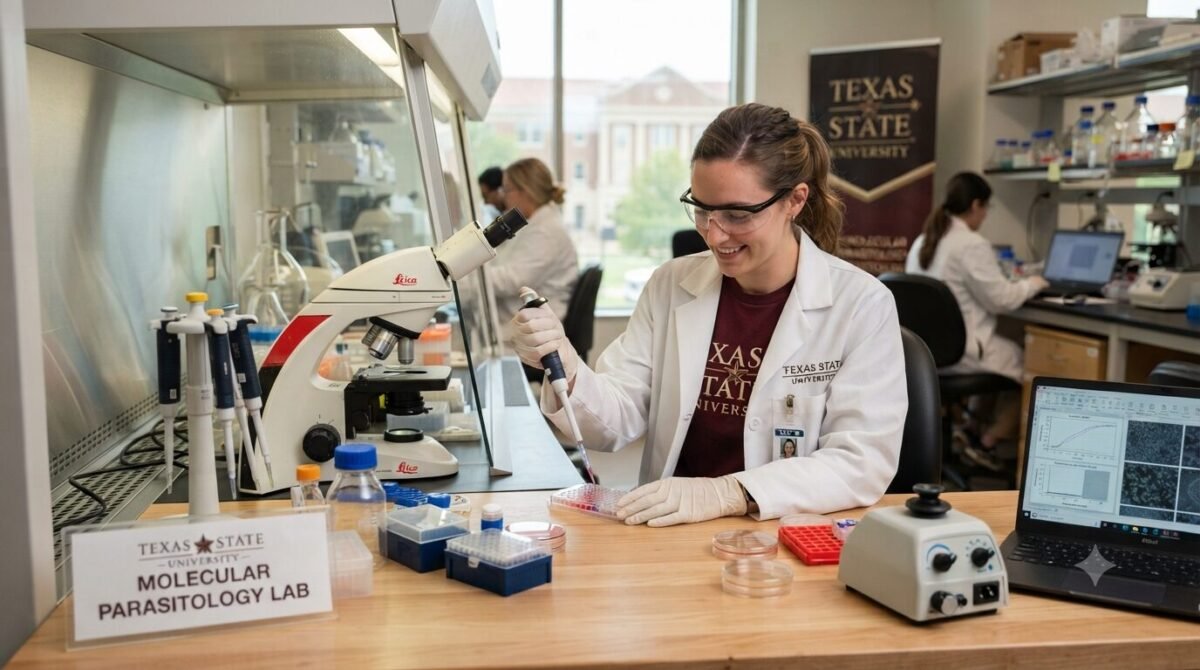
Study in US Freely through Fully Funded PhD Scholarship Program in Molecular Parasitology at Texas State University 2027 intake Offers an exciting opportunity for domestic and international students interested in molecular parasitology, malaria pathogenesis, infectious diseases, microbiology, immunology, cell biology, genetics, and biomedical sciences to pursue doctoral research in the United States.
What Important Information Should Applicants Know About the Scholarship?
| Scholarship Information | Details |
|---|---|
| Host Institution | Texas State University |
| Research Area | Molecular Parasitology |
| Degree Level | PhD |
| Study Location | United States of America |
| Scholarship Type | Fully Funded |
| Eligible Nationalities | Domestic and International Applicants |
| Main Research Focus | Malaria Pathogenesis |
| Research Laboratory | Mukherjee Lab |
| Expected Start | Spring 2027 |
| Application Review/Deadline | 15 August 2026, according to the source announcement |
| Application Method | Email application materials as instructed in the announcement |
| Relevant Fields | Biology, Molecular Biology, Microbiology, Genetics, Immunology, Biomedical Sciences and related disciplines |
What Benefits Does the Texas State University PhD Scholarship Offer?
Candidates who get selected may have the following benefits:
- Tuition fees
- Provide stipend annually
- Health insurance support
- Access to state-of-the-art molecular biology laboratories
- Expert guidance by faculty mentors
- Possibility of publishing research articles
- Scholarships for attending scientific meetings (if available)
- Career and international research networking prospects
READ: Ubungo Municipal Council Announces 180 Revenue Collector Jobs – Apply Before 14 August 2026
What Can Students Research Through This PhD Opportunity?
Research areas may include:
- Molecular Parasitology
- Malaria Pathogenesis
- Host Parasite Interactions
- Cell Biology
- Microbiology
- Immunology
- Protein Biology
- Microscopy and Imaging
- Functional Genomics
- Drug Target Discovery
- Infectious Disease Research
- Biomedical Sciences
Who Can Apply for the Molecular Parasitology PhD Scholarship?
Applicants will be required to:
- Be a domestic or international applicant.
- Hold a Bachelor’s or a Master’s degree in Biochemistry, Molecular Biology, Genetics, Biomedical Sciences, Biology, Microbiology, Biotechnology, or any related area.
- Have excellent academic standing.
- Be highly interested in the study of molecular parasitology and infectious diseases.
- Meet the graduate admission criteria of Texas State University.
- Be proficient in English language (international applicants only).
What Documents Are Required for the Application?
The scholarship announcement specifically mentions the following application materials:
- Curriculum Vitae (CV)
- Cover Letter outlining:
- Research experience
- Academic interests
- Career goals
When Is the Application Deadline for This PhD Opportunity?
Application review starts from 15 August 2026 and interested applicants are able to apply as soon as possible since the position is open until it gets filled up.
Get More Opportunities
Scholarships For International Students
How Can You Apply for the Texas State University Molecular Parasitology PhD?
The Texas State University PhD in Molecular Parasitology 2027 can be applied to through sumit.mukherjee@txstate.edu. Attach all the requested documents listed above.
Frequently Asked Questions (FAQs)
1. What is the Texas State University Molecular Parasitology PhD Scholarship?
It is a doctoral research opportunity focused on molecular parasitology and malaria pathogenesis at Texas State University in the United States.
2. Is the Texas State University PhD scholarship fully funded?
The published opportunity is described as fully funded and lists tuition support, an annual stipend, health insurance support, and other research-related benefits.
3. Who can apply for the Molecular Parasitology PhD?
Both domestic and international applicants may apply, provided they meet the academic and program-specific requirements.
4. What degree is offered through this opportunity?
The opportunity is for a PhD-level research position in Molecular Parasitology.
5. Where is the PhD scholarship located?
The opportunity is based at Texas State University in the United States.
6. When does the PhD program start?
The scholarship announcement indicates that the position is intended for Spring 2027.
7. What is the application deadline?
The source announcement lists 15 August 2026 as the application date and states that the position may remain open until filled.
8. What research area does the PhD focus on?
The main research focus is molecular parasitology, particularly the molecular mechanisms of malaria parasites and their interactions with host cells.
9. Can international students apply?
Yes. The published announcement states that applicants from all nationalities are eligible, subject to the relevant university admission requirements.
10. What bachelor’s degrees are relevant?
Relevant backgrounds include Biology, Molecular Biology, Biochemistry, Microbiology, Genetics, Biotechnology, Biomedical Sciences, and related disciplines.
11. Is a master’s degree required?
The scholarship announcement indicates that applicants may hold either a bachelor’s or master’s degree in a relevant field. However, applicants should confirm the specific doctoral admission requirements before applying.
12. Is laboratory experience required?
The announcement states that prior laboratory or research experience is preferred but not compulsory.
13. What documents should applicants prepare?
Applicants should prepare an academic CV and cover letter, while also being ready to provide transcripts, recommendations, English-language evidence, and other documents required by the university.
14. What should the cover letter contain?
The cover letter should explain your research experience, academic interests, career goals, and motivation for pursuing molecular parasitology research.
15. Will students receive a stipend?
The published scholarship information states that selected students may receive an annual stipend as part of the funding package.
16. Does the scholarship cover tuition fees?
Yes. Tuition fee support is listed among the benefits of the opportunity.
17. Is health insurance included?
Health insurance support is listed among the benefits in the published scholarship announcement.
18. Can students publish research papers?
Yes. The opportunity provides the possibility of publishing research findings in peer-reviewed scientific journals.
19. Can PhD students attend scientific conferences?
Students may have opportunities to attend scientific meetings, with conference support listed as a potential benefit where available.
20. What is malaria pathogenesis?
Malaria pathogenesis refers to the biological processes through which malaria parasites interact with their hosts and cause disease.
21. What other research fields are connected to this PhD?
Related fields include cell biology, microbiology, immunology, genetics, protein biology, functional genomics, microscopy, drug-target discovery, and biomedical sciences.
22. Do international applicants need an English test?
International applicants generally need to satisfy Texas State University’s English proficiency requirements unless they qualify for an applicable exemption.
23. Is there an application fee for Texas State University graduate programs?
Texas State’s general graduate admission policy lists a nonrefundable application fee of $55, or $90 for applications involving international credentials. Program-specific instructions should be checked before applying.
24. Does meeting the minimum requirements guarantee admission?
No. Texas State University explains that meeting institutional minimum requirements does not guarantee admission because individual graduate programs may have additional requirements and selection criteria.
25. How should applicants apply for this PhD opportunity?
Applicants should follow the application instructions provided for the Molecular Parasitology position and complete any required Texas State University graduate admission application and supporting documentation.